Sunday 15 / November / 2026
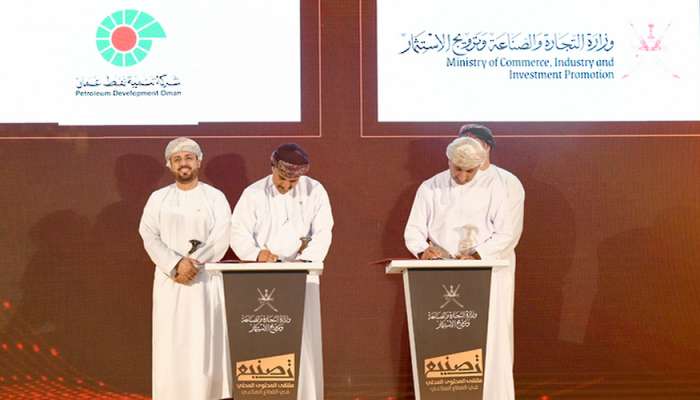
Muscat--- The Local Content Forum in the Industrial Sector, organized today by the Ministry of Commerce, Industry and Investment Promotion, included the launch of initiatives to enhance local content in the industrial sector. It also featured the signing of cooperation programs with a number of institutions and companies.
These agreements aim to localize supply chains and production inputs, develop local suppliers, provide financing enablers for industrial projects, support the qualification of national competencies, and enhance the presence of Omani products in markets, in alignment with the targets of the Industrial Strategy 2040 and Oman Vision 2040.
The forum was held under the auspices of Eng. Badr Salim Al Maamari, Chairman of the Projects Tenders and Local Content Authority.
Organizing the forum comes within the framework of the ministry’s efforts to realize local content targets into actionable programs and projects. It also aims to enhance integration between national factories, major companies, and local suppliers, contributing to increasing the added value of industrial activities, expanding investment and commercial opportunities, and enhancing the industrial sector's contribution to economic diversification.
Eng. Ghalib Said Al Maamari, Undersecretary of the Ministry of Commerce, Industry and Investment Promotion for Commerce and Industry, affirmed that enhancing local content represents one of the strategic pathways for developing the industrial sector and raising its contribution to the national economy. He noted that the upcoming phase requires shifting from focusing on the volume of industrial production to maximizing the economic value achieved by industrial facilities within the Sultanate of Oman. This is accomplished by localizing procurement and production inputs, developing intermediate and support industries, and opening broader opportunities for local suppliers and small and medium enterprises.
He said that the ministry's direction toward enhancing local content is based on building a more integrated industrial ecosystem where national factories benefit from the opportunities available in supply chains and major projects, and where industrial procurement transforms into new investment and production opportunities. This reduces reliance on imports in areas where local manufacturing capabilities exist, and enhances the sustainability of the industrial sector and its competitiveness.
He added that the cooperation programs witnessed at the forum reflect the importance of partnership between the public and private sectors in achieving these directions. He clarified that the ministry is working on providing the regulatory, financing, and technical enablers that help industrial facilities expand. It also encourages major companies to utilize national products and services, and develops mechanisms to measure local content and link industrial initiatives to tangible economic results.
The Undersecretary pointed out that the success of these efforts is linked to the ability of industrial institutions to adopt clear plans for developing local suppliers, transferring knowledge and technology, and investing in national competencies. He affirmed that local content is not limited to substituting imported products, but extends to creating new industries, raising productivity, and expanding the base of Omani exports.
Eng. Khalid Sulaiman Al Qasabi, Director General of Industry at the Ministry of Commerce, Industry and Investment Promotion, affirmed in his speech that the industrial sector continues to consolidate its position as one of the main drivers of economic diversification, based on the Royal Directives of His Majesty Sultan Haitham bin Tarik aimed at empowering the Omani product and enhancing the competitiveness of the national economy.
He clarified that the industrial sector's contribution reached 9.4 percent of the Gross Domestic Product (GDP) during 2025. Meanwhile, the number of active industrial institutions rose to 31,183, registering a 5 percent growth compared to 2024.
He pointed to a 10 percent increase in the number of Omani workers in the industrial sector, reaching approximately 53,000 Omani workers during 2025, compared to about 48,000 in 2024. He affirmed that these indicators reflect the sector's role in providing job opportunities and enhancing the participation of national competencies in productive activities.
He added that non-oil commodity exports recorded a growth of 7.5 percent, with their value rising from RO 6,232,000,000 in 2024 to RO 6,698,000,000 by the end of 2025, serving as an indicator of the growing competitiveness of national products in foreign markets.
He indicated that the cumulative value of foreign direct investment in the manufacturing sector reached approximately RO 2,759,000,000, reflecting the investment opportunities provided by the sector.
Al Qasabi affirmed that local content transcends the concept of spending and procurement to encompass the development of an integrated industrial ecosystem based on localizing production inputs, enhancing linkages between major factories and small and medium enterprises, transferring technology, and developing national skills. He noted that the ministry continues to develop policies and initiatives supporting this direction, including the "Made in Oman" identity, the "Tasnee" (Manufacturing) platform, and local content programs in the industrial sector.
The forum's program included a visual presentation titled "Creating Impact," which addressed the importance of local content in maximizing the economic return from industrial activities. This was followed by a presentation of the local content tool in the industrial sector and its role in supporting the measurement of industrial facilities' contribution to local content development, and enhancing institutions' ability to identify localization opportunities and improve their performance in this field.
The forum also witnessed the review of some successful experiences in localizing products and technologies for industrial facilities. Flex Pharmaceutical Industries presented an overview of developments in manufacturing medical and pharmaceutical supplies, and the investment opportunities available to expand the local production base in pharmaceutical industries.
Voltamp Energy Company reviewed its experience in localizing the transformer industry and electrical technology, and the progress it achieved in developing national manufacturing capabilities. This highlighted the role of industrial companies in enhancing local content and transferring knowledge and industrial technologies.
The forum witnessed the launch of the Comprehensive Guide for Enhancing Local Content Elements in the Industrial Sector. It aims to provide a unified reference that helps industrial facilities identify local content elements and measure their contribution to the national economy. This includes local procurement, employment of national competencies, localization of production inputs, and maximizing the utilization of national suppliers and services.
Furthermore, the first edition of the annual industrial exhibition "Made in Oman" was announced. It aims to highlight the capabilities of national industry, introduce Omani products, and expand communication opportunities between manufacturers, buyers, and consumers, thereby supporting the national product's presence in markets.
The forum also included the announcement of an initiative in cooperation with the Ministry of Labour and the Sectoral Skills Unit for Industry. It aims to provide 2,000 subsidized occupational licenses for job seekers and graduates in a number of technical and specialized professions in the industrial sector with low Omanization rates, according to the occupational classification and licensing system approved by the Ministry of Labour. This contributes to qualifying national competencies and empowering them to fill the targeted industrial jobs.
In the context of enhancing partnership with industrial and economic institutions, the forum witnessed the signing of a number of cooperation programs aimed at supporting local content, developing suppliers, and expanding opportunities for national facilities to benefit from industrial procurement and major projects.
These included cooperation programs with the Development Bank to implement the "Tahqeeq" (Achievement) initiative. This aims to provide the necessary enablers and appropriate financing solutions for targeted industrial projects and facilities, facilitating their access to the required funding to expand and develop their production operations.
A cooperation program was also signed with Petroleum Development Oman (PDO) to benefit from its expertise in applying local content practices and developing local suppliers, contributing to empowering factories and localizing supply chains in the industrial sector.
The cooperation programs also included Sohar Aluminium, aiming to enhance integration between the aluminum industry and local manufacturing industries, and increase reliance on Omani factories to provide products and supplies related to this industry.
Additionally, a cooperation program was signed with Vale Oman to enhance local content elements in its iron and steel pelletizing complex, increase the percentage of local procurement of industrial supplies, and support the localization of technologies and services related to industrial operations.
The forum also featured the signing of a cooperation program with Oman Cables Industry, and agreements to support the empowerment of national products in housing projects, as part of efforts aimed at expanding opportunities to utilize Omani industries in various projects.
The forum further witnessed the signing of a cooperation program with Talabat to enhance the marketing of Omani products bearing the "Made in Oman" logo. This is done by allocating a category for national products on the "Talabat Oman" application, contributing to expanding their access channels to consumers, increasing awareness of local products, and encouraging their purchase.
Sultan Said Al Khadouri, Head of the Local Content Office at the Ministry of Commerce, Industry and Investment Promotion, clarified that the forum represents a practical platform to link the needs of major industrial companies with the available production capabilities of local factories and suppliers. This helps in identifying opportunities that can be transformed into new industrial projects or expanding their local manufacturing scope.
He stated that one of the challenges the ministry is working to address is creating more effective channels for exchanging information between industrial facilities and suppliers. This allows national factories to identify the procurement and production input needs of major companies and prepare to meet them in accordance with approved specifications and technical requirements.
He added that the Local Content Office at the ministry is working on developing tools that help industrial facilities evaluate their performance in the area of local content and identify areas through which their contribution to the national economy can be increased. He pointed out that the Comprehensive Guide for Enhancing Local Content Elements constitutes one of the tools supporting the unification of concepts and methodologies, helping facilities prepare measurable and developable plans.
He affirmed the importance of utilizing the cooperation programs announced during the forum in building sustainable supply relationships and encouraging investment in intermediate and support industries.
He clarified that the priority during the upcoming phase is following up on the implementation of these programs and identifying industrial opportunities that can achieve a direct impact in increasing local procurement and developing national suppliers.
An interactive executive workshop titled "Enhancing Local Content in the Industrial Sector" was also held, with the participation of a number of executive leaders, decision-makers, supply chain and procurement officials, and representatives of government entities, local suppliers, and small and medium enterprises.
The workshop included a review of Voltamp's experience in the "Watanaha" (Her Homeland) initiative, presented by Yousef Al Balushi, General Manager of Voltamp Technology. During the presentation, he addressed the mechanisms for developing local suppliers, the challenges the company faced, and the lessons learned from its experience.
Additionally, Mazen Al Siyabi, a researcher in international trade, presented a working paper on the economic impact of local content in the industrial sector. It addressed its role in increasing added value, enhancing the contribution of national industries, and creating business and investment opportunities.
The workshop featured interactive working sessions divided into four main themes: clean energy and mining, food security, petrochemicals, and government procurement and tenders. These aimed to discuss opportunities for localizing products, services, and production inputs, identify the challenges facing local suppliers and factories, and propose appropriate solutions and initiatives to address them.
Amira Al Shabibi, an Industrial Planning Engineer at the Local Content Office at the Ministry of Commerce, Industry and Investment Promotion, said that the workshop was designed to be a space for direct dialogue between industrial leaders and relevant entities. This allows for moving from discussing general challenges to identifying specific industrial opportunities that can be developed in cooperation with concerned partners.
She clarified that the four themes were chosen due to their association with promising opportunities to enhance local content. The clean energy and mining theme focused on opportunities to manufacture components, equipment, and services related to these activities.
The food security theme addressed localizing production inputs, food processing, packaging, and cold chains. The petrochemicals theme discussed opportunities in manufacturing industries, polymer-based products, and recycling. Meanwhile, the government procurement and tenders theme focused on enhancing the national product's utilization of contracts and projects, and developing mechanisms to qualify local suppliers.
She added that the workshop's methodology relied on dividing participants into working groups. Each group was tasked with identifying two opportunities to enhance local content, two main challenges, and two practical solutions or proposals. They then selected a priority opportunity, a challenge requiring addressing, and a proposal ready for implementation.
She pointed out that the targeted outcomes from the workshop include identifying developable investment and industrial opportunities, monitoring the most prominent challenges facing supply chains and national factories, and proposing executive initiatives that can be followed up on in coordination with the competent authorities. She affirmed that the importance of these outcomes lies in the possibility of utilizing them to guide future initiatives and enhance integration between major companies, factories, and local suppliers.
The workshop concluded with a review of the working groups' outcomes and a discussion of the proposals and priorities presented, in preparation for utilizing them in developing programs and initiatives supporting local content in the industrial sector.
The Ministry of Commerce, Industry and Investment Promotion, represented by the Directorate General of Industry, continues its efforts to enhance the competitiveness of the industrial sector and increase its contribution to the national economy. This is achieved by developing industrial policies and enablers, stimulating investment in manufacturing and intermediate industries, supporting the Omani product, and expanding partnerships with the private sector. These actions enhance local content and consolidate the national industry's role in achieving the targets of economic diversification and sustainable development.