Tuesday 10 / November / 2026
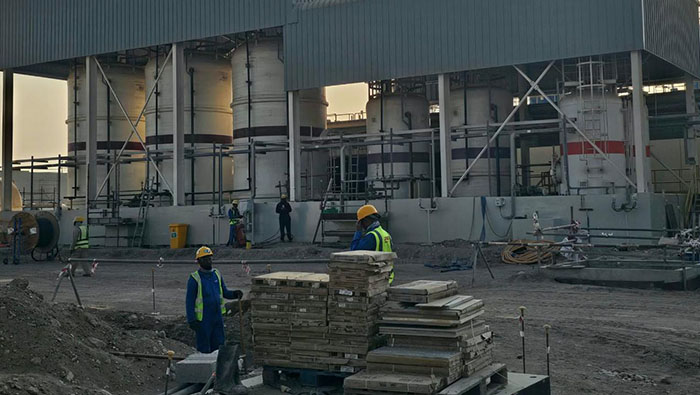
Muscat: The Authority for Public Services Regulation (APSR) has announced that construction work on the Al Ghubrah 3 desalination plant project in Muscat Governorate has reached 93 percent completion. The project involves investments of up to OMR125 million and has an expected production capacity of 300,000 cubic metres of desalinated water per day. This is equivalent to the average needs of about 188,000 water accounts based on actual production data, representing around 54 percent of all water accounts in Muscat Governorate.
The authority indicated that the plant is expected to begin operation in early the second quarter of 2027. The project comes within the framework of Oman's interest in developing water sector infrastructure and enhancing water security, keeping pace with population and urban growth, and raising the efficiency, reliability and sustainability of water supplies.
It explained that the project represents a strategic addition to the water system by increasing production capacity and supplying the network with additional quantities of desalinated water. This will help meet growing demand in Muscat Governorate, support service continuity for subscribers, and enhance the system's readiness to keep pace with urban expansion and the needs of residential areas and economic and service activities.
On operations and national capacity development, the authority stated that the project provides nearly 100 job opportunities for citizens during the implementation and operation phases, with the Omanisation rate during the operation phase expected to reach about 94 percent. It affirmed that these opportunities enhance the participation of Omani talent in technical and operational fields and support the acquisition of specialised expertise and skills in desalination and plant management, in addition to providing sustainable jobs in one of Oman's vital sectors.
The authority pointed out that the project makes a tangible contribution to supporting local added value, with the value of Omani local content in the project reaching about OMR40 million, while the contribution of small and medium enterprises (SMEs) exceeded OMR1.5 million. These indicators reflect the scale of national companies' participation in implementing projects and the role of water sector investments in stimulating related business and enabling local enterprises to benefit from major development projects.
The authority added that involving Omani companies and small and medium enterprises enhances the project's economic impact by supporting their presence in works and services related to implementation and expanding their contribution to infrastructure development. This helps direct part of the returns from these investments into the local economy.
On the technical side, the authority explained that the Al Ghubrah 3 plant uses reverse osmosis technology for desalination, which helps enhance energy and resource use efficiency and raise operational efficiency. It noted that the use of modern technologies in the project supports production sustainability, raises resource use efficiency, and strengthens the plant's ability to meet growing water needs.
The authority added that the project, implemented by Nama Power and Water Procurement Company, brings together local and international expertise in desalination through an alliance of three international and local companies: Spain's GS Inima, Saudi Arabia's Al Jomaih Energy and Water, and Oman's Sugecs. This reflects the commitment to developing the water sector and attracting specialised expertise to implement projects that support the system's efficiency and the sustainability of its services.
The Authority for Public Services Regulation also affirmed that the inauguration of the plant in early the second quarter of 2027 will enhance the water system's ability to respond to development requirements and urban expansion in Muscat Governorate. It will combine increased production with support for national operation and local added value, entrenching the water sector's contribution to national economic development and enhancing the sustainability of essential services for society.