Monday 09 / November / 2026
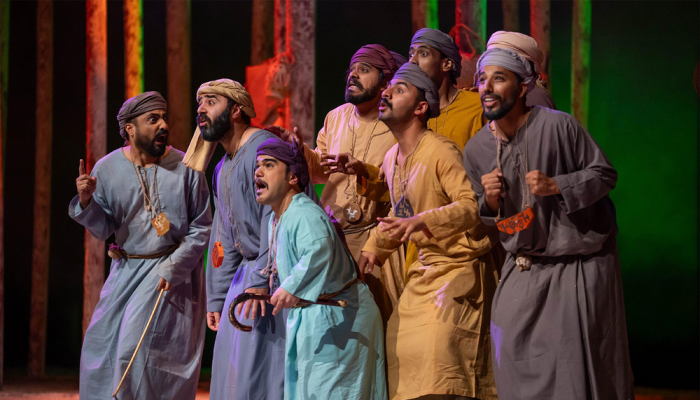
Muscat: Omani theatre artist Omair Anwar Al Balushi believes that the foundations and contexts of impactful theatre begin when it grants the spectator an elusive sensation, in body and voice. A person may live under pressure, fear, or a sense of injustice for years, then see a scene and say, "This is what I was trying to explain." Speaking to the Oman News Agency (ONA), he expressed his wish that his experience might one day bear the trace of a human being who kept learning, and who left those who come after him a space from which to advance.
The artist, whose artistic stations have encompassed both theatre and television, said that the impact he creates here, in his moment, is something he considers together with what follows it, for the spectator sees the event and must then tell of its impact. On the earliest beginnings of his career and the ardour required to align with the experience of acting, he said: "Every character I perform makes me revisit a judgement I had thought final about people. In life, we can reduce a person to a single word—weak, selfish, cruel—but when I perform that person, the word becomes insufficient; I must search for what he fears, what he has lost, and how he arrived at this moment." From this, a wisdom took shape within him that he began to walk by as an existential logic.
He explained: "This is why acting has made me slower to pass judgement, and more attentive to what people conceal behind their behaviour. This understanding does not mean justifying every course of conduct, but it grants me the chance to see the human being in all his contradictions. Acting teaches a person and grants him a different vision that influences his view of life. With every role, I discover something about myself as well; sometimes I find in the character a fear I know well, or a courage I wish I possessed. I enter the role searching for someone else and emerge from it having come to know a part of myself." This, he said, has helped him raise his level of social awareness and his understanding of the differences among human cultures and behaviours.
He says: "I think of an artistic project as a question that stays with me and evolves as my experience changes. I may perform distant characters, yet what can unite them is my preoccupation with the human being—how he preserves his dignity, what fear does to him, and when he possesses the courage to change. The presence of this question helps me understand my choices, notice what I repeat, and recognise what I have not yet dared to try. Sustainability, too, requires training, reading, honest self-review, and the documentation of experiences, so that those who come after us may read them and build upon them. It also matters to me that expertise be passed on to others through work, training, and dialogue; what I learn acquires a wider life when it becomes useful to another artist."
On the role of theatre in influencing the audience and provoking thought, the artist noted: "For me, impactful theatre begins when it grants the spectator an elusive sensation, in body and voice. A person may live under pressure, fear, or a sense of injustice for years, then see a scene and say, 'This is what I was trying to explain.' Expressing the audience requires listening to it; I cannot speak on people's behalf while distant from the details of their lives, or assume that I know their needs better than they do."
Reality may leave the audience with a number of questions, and theatre contributes to answering them. As an actor, Omair Al Balushi offers another clarification here: "I do not enter a performance to distribute answers; what matters to me is to create a situation that makes the audience reconsider its own answer—to empathise with a character and then be surprised by her conduct, and ask why I empathised with her and what I would have done in her place. Awareness may begin in a moment when the spectator hesitates before judging, and theatre is capable of granting us that moment."
He indicated this in his words: "I believe in the artist's freedom, and I see its value in his ability to bear the responsibility of his choices. Before I present a sensitive scene, I ask myself: why do I need it, what will it reveal, and do I understand the people whose experience I am addressing? An actor's freedom begins with respect for society, and respect for society includes dealing seriously with its questions and its pains, and allowing space to discuss what is difficult to say. In turn, the audience has the right to discuss the work and disagree with it, just as the artist has the right to clarify his vision."
Regarding the human being on stage and before the camera, as not being identical copies, Al Balushi says: "I am careful to distinguish between the character's position and my own. I may embody a person who holds ideas I reject, because exposing these ideas and their consequences is part of the function of drama. When I am able to explain the necessity of my choice artistically and humanly, I am closer to the freedom I believe in."
On linking theatre to cultural identity, Omair says: "I see that presenting Omani identity begins with knowing the Omani person and his relationship to his land and his family, his manner of joy and sorrow, what he says and what he refrains from saying. Costume, music, and dialect are important elements, but their presence requires meaning within the work. When I use folk art, I ask: what does it add to the scene, does it reveal a relationship, does it move an event, does it carry the character's memory? These questions help me move beyond ornament to drama. Oman, in its alphabets, grants the artist a wide diversity of environments, voices, and experiences, and it is my responsibility to approach this diversity with knowledge and respect. I aspire to a work in which the Omani spectator can recognise himself, and through which a spectator from beyond the local geographic borders can come to know Omani society; here, particularity becomes a gateway to communication."
On receiving the award for Best Actor at the competition of the Literary and Artistic Forum, held in the Wilayat of Sohar in North Al Batinah Governorate, he said: "This honour delighted me. As I receive it, I remember that the audience sees an actor before it, but behind this presence lies the effort of an entire team—people who gave the performance their time, their trust, and their toil. The award grants the artist a beautiful impetus and tells him that something of his effort has landed. It is also an appreciation of a specific experience within its context; therefore I rejoice in it and try to understand what succeeded in the experience and what needs development." Because his ambition is greater than what he has reached, he said: "I only fear that an artist may become attached to the image for which he was rewarded, and repeat it in search of new appreciation. I would like the award to grant me the courage to venture, and I hope that the most beautiful thing to come after it will be a role that asks me to begin learning anew."
On his relationship with local television drama, as it has a different resonance, he explained: "On stage, I feel that I carry the character's entire journey in my body; I follow her development, live her rhythm, and exchange energy with the actors and the audience in the same moment—even silence is affected by the breathing of the hall. Before the camera, the distance changes; a small movement in the eye may become an entire event, and any excess effort may show clearly.
Filming may also ask me to perform the end of the experience before its beginning, so I need precise knowledge of the character's psychological position in every scene. The depth of human experience can be great in both mediums; my challenge is controlling the manner of its arrival—how I make the last spectator in the theatre feel me, and how I allow the camera to come close without explaining everything to it." He summed up the two experiences in a phrase: "Theatre teaches me the extension of the moment, and the camera teaches me its density."
As for the future and the impact of digital transformations on all fields of life, including theatre, he says: "I see that digital transformations invite us to rethink the value of the live encounter. Today's spectator can reach entire worlds from his phone, and so the question becomes: what experience do we offer that deserves leaving one's home for?
Theatre possesses the particularity of an encounter between human beings who share time and place—a laugh that travels between the seats, a silence that everyone feels, and a moment that takes shape before them with all its possibilities. From here comes our responsibility to present accomplished works close to people's questions and experiences. Perhaps, in my field as a theatre specialist, these questions are present in my thinking and planning; I think about how to keep pace with developments, harness digital transformations in the service of theatrical creativity, widen access to the audience, and build a continuous relationship with it—one that begins before it enters the hall and extends after the performance ends."
To continue the journey, he states: "That requires continuity in presenting performances, clear schedules, effective communication, and a comfortable experience of attendance. Digital platforms can open the door of curiosity, bring the audience closer to the work and its makers, and ease access and participation for it. I aspire for the audience to know when to find us, and to find in every visit something that invites it to return; the future of theatre is shaped by our ability to build this trust and renew it, performance after performance."