Thursday 05 / November / 2026
Muscat: The Sultanate of Oman is participating with countries around the world in celebrating International Prosthetics and Orthotics Day, which focuses on the importance of specialised services in improving the mobility of persons with disabilities, supporting their independence, and enhancing their integration into society.
In this framework, the Prosthetics and Orthotics Department at Khoula Hospital continues to provide its specialised and rehabilitative services to various age segments through the evaluation, design, manufacturing, and fitting of prosthetic limbs and orthotic devices, thereby contributing to improving the beneficiaries' motor capabilities, enhancing their self-reliance, and assisting them in carrying out their daily activities.
Zakia Said Al Noubi, Head of the Prosthetics and Orthotics Department at Khoula Hospital, told Oman News Agency (ONA) that the department recorded 10,828 visits during the year 2024 and dispensed 5,326 devices, while the number of visits increased during the year 2025 to 11,074 visits, with the number of dispensed devices reaching 5,534 devices.
She added that the department is keen on providing integrated specialized services that take into account the needs of each beneficiary, starting from assessing the condition and identifying requirements, passing through selecting, manufacturing, and fitting the appropriate prosthetic limb or orthotic device, and reaching follow-up, adjustment, and maintenance, ensuring the suitability and efficiency of the devices and achieving the best possible rehabilitative outcomes.
She pointed out that the services provided by the department are not limited to supplying prosthetic limbs and orthotic devices, but extend to accompanying the beneficiary through various stages of rehabilitation and enhancing their ability to move and rely on themselves, emphasising the importance of integrating technical expertise with human care when addressing patients' needs.
She noted that the department provides lower-limb prostheses at various levels, including below-knee, above-knee, and hip disarticulation cases, alongside upper-limb prostheses for below-elbow and above-elbow levels, cosmetic silicone prostheses, as well as compensatory devices for cases of congenital short lower limbs and severe limb length discrepancies.
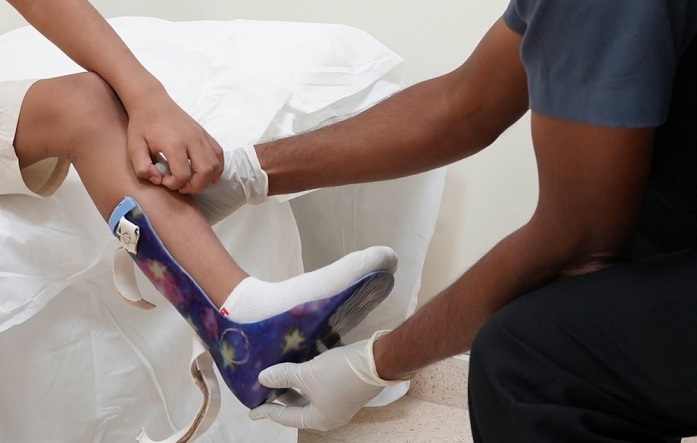
She stated that in the field of orthotics, the department offers a range of services including medical foot insoles, ankle-foot orthoses (AFOs), knee-ankle-foot orthoses (KAFOs), spinal orthoses, dynamic upper-limb devices, and cranial orthotic helmets, in addition to providing pre-made devices and custom-fabricated devices designed specifically according to each patient's needs, through stages beginning with taking measurements and casts, passing through manufacturing and fitting trials, and concluding with final alignment and installation.
She mentioned that the services provided include maintenance, adjustment, and periodic follow-up of devices and prosthetic limbs, including replacing parts, joints, and prosthetic feet when necessary, troubleshooting malfunctions and abnormal sounds and changing straps, belts, and worn components. These services also include modifying or replacing devices according to changes in the patient's weight and body structure, and providing new devices for children in line with their growth stages and increasing height.
She explained that the department works in collaboration with several medical specialties, including orthopedic, neurological, plastic, general, vascular, and hand surgery, alongside physical therapy, occupational therapy, and podiatry. It also participates in multidisciplinary clinics to evaluate patients before and after surgical interventions and determine the appropriate devices to support rehabilitation phases.
For his part, Atif Mohammed Al Shaizani, one of the beneficiaries of the department's services, stated that he was involved in a traffic accident in 2024 while riding a motorcycle, which resulted in the loss of one of his legs, noting that the accident represented a difficult phase in his life that required him to adapt to new circumstances and face multiple challenges.
He added that receiving the prosthetic limb, along with the follow-up and rehabilitation he received from the specialised staff in the department, contributed to helping him restore his ability to move, carry out his daily activities better, and boost his self-confidence and independence.
He expressed his appreciation for the efforts exerted by the medical and technical staff in the department, praising the care and support he received throughout the rehabilitation stages, and emphasising that prosthetics services represent an important step in restoring independence and improving quality of life.
These efforts come within the framework of enhancing specialised health and rehabilitation services, as well as developing the care system provided to individuals in need of prosthetics and orthotics, supporting their active participation in society and contributing to improving their quality of life.