Wednesday 07 / October / 2026
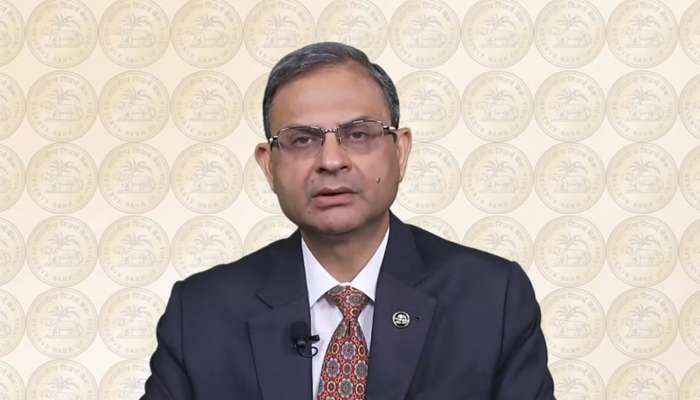
New Delhi: Reserve Bank of India Governor Sanjay Malhotra on Wednesday raised the country's real GDP growth projection for the current financial year 2026-27 by 40 basis points to 7.1 per cent, citing the strength of economic activity despite global headwinds.
Announcing the outcome of the RBI Monetary Policy Committee meeting, Malhotra said geopolitical tensions, elevated international commodity prices, additional frictions in global trade and tightening global financial conditions could weigh on India's growth outlook.
"Taking all these factors into consideration, real GDP growth for this year is projected at 7.1 percent, with Q2 at 7.2 percent, Q3 at 6.9, and Q4 at 6.8 percent," Malhotra said.
He said the 40 basis points upward revision reflected the strength of economic activity despite the significant global challenges.
The RBI Governor said India's real GDP growth stood at 7.8 per cent in Q1, supported by resilient private consumption and strong investment activity, which recorded almost a 12 per cent increase. The contribution of net exports also remained positive.
"We exhibited resilience amidst global headwinds, as evident from real GDP growth of 7.8 per cent in Q1," Malhotra said.
He said high-frequency indicators for Q2 suggest that economic activity is maintaining momentum, although with some moderation compared with the previous quarter.
Manufacturing activity has remained steady despite cost pressures, while services sector activity has stayed broad-based, supported by higher domestic and external demand. Both manufacturing PMI and services PMI remained in the expansionary zone in Q2, although the pace of expansion slowed from Q1.
Private consumption remained broadly resilient, supported by discretionary spending, while fixed investment continued to remain strong.
However, the RBI Governor said some weakness was visible in non-durable goods and domestic air passenger traffic.
Merchandise exports registered higher double-digit growth during July and August, supported by efforts to expand market access and diversify markets. Services exports also recorded accelerated growth during the two months.
Looking ahead, Malhotra said global economic uncertainty and supply chain disruptions could affect domestic economic activity. He also said a weak southwest monsoon and strong El Niño conditions could affect the upcoming rabi season and rural demand.
He said continued infrastructure spending, a rebound in private capex and strong credit flows are expected to support investment activity. Services exports are expected to remain buoyant, while recently operationalised bilateral trade agreements should support merchandise exports.




