Monday 31 / August / 2026
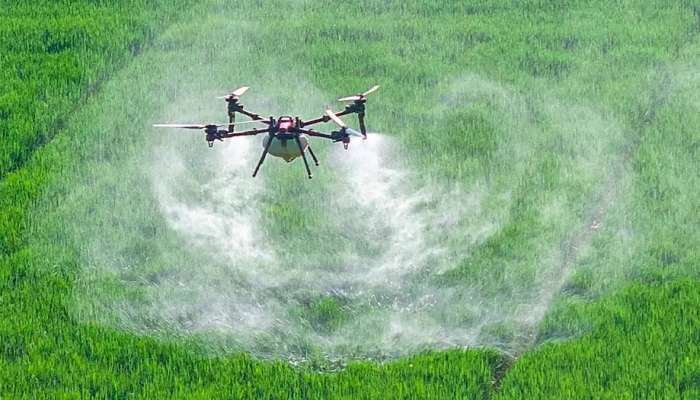
Brussels: In theory, the idea doesn't sound bad: Instead of using tractors to spray large quantities of pesticides over fields, drones could precisely spray herbicides, fungicides and insecticides only where they are actually needed.
The plan would be to scan a field, identify affected areas and treat them selectively — significantly reducing pesticide use, according to the European Union's Omnibus X legislative package, which aims to simplify EU food and feed safety rules. After all, the bloc aims to halve the use of chemicals for plant protection by 2030.
Until now, however, the EU had a decades-old ban on spraying pesticides from the air over agricultural land. Exceptions applied only to difficult-to-work terrain, such as steep vineyard slopes. Omnibus X is now set to change that. In May, the European Council gave the legislative package the green light.
Drone use doesn't automatically mean less pesticides
"I think it makes sense in principle to distinguish spray drones from conventional aerial application from a regulatory perspective," said Thomas Daum, an agricultural economist and human ecologist at the School of Global Studies at the University of Gothenburg. Daum studies new technologies and their impact on agriculture. Compared with an airplane or helicopter, he said drones can generally spray more precisely.
However, Daum also cautioned that "the drone itself does not save any pesticide." He sees potential for using drones to respond more selectively to pest infestations — and thus reduce overall pesticide use. Another advantage for farmers could be the ability to respond quickly to an infestation "even when soils are wet or in difficult-to-access terrain."
"At the same time, this flexibility lowers the barriers to treatment and could therefore also lead to spraying being carried out more frequently overall," Daum said. This could result in a technological lock-in — meaning that more efficient application could reinforce dependence on chemical crop protection.
Omnibus X aims to save administrative costs, cash
Chemical pesticides have been cause for concern for many researchers. Omnibus X is intended not only to make it easier to use spray drones, but also to change the way pesticides are approved.
When the European Council approved Omnibus X in May, a group of researchers from 27 European research institutions voiced strong criticism. Among them was Carsten Brühl, a biologist at the Institute for Environmental Sciences at the Rheinland-Pfalz Technical University of Kaiserslautern-Landau. Brühl, who studies the effects of pesticides on the environment, called Omnibus X a "deregulation package" and is deeply alarmed by it.




