Sunday 09 / August / 2026
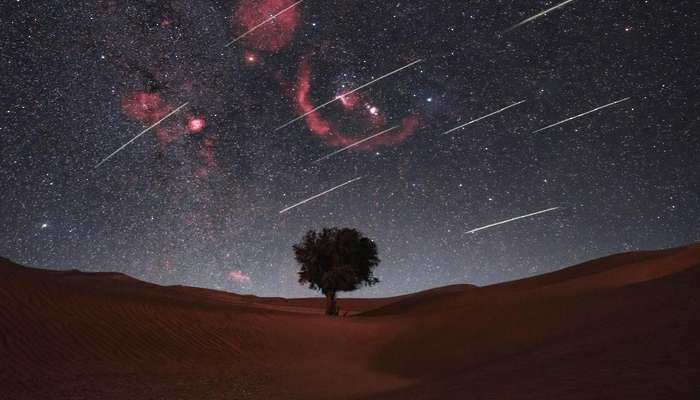
MUSCAT:— The skies over the Sultanate of Oman are currently witnessing the annual Perseid meteor shower, one of the most spectacular astronomical events of the year, with the phenomenon visible to the naked eye from dark locations away from artificial lights.
According to the Oman News Agency, the Perseids will continue until August 24, reaching their peak on the night of August 12–13, when observers under ideal conditions could see 80 to 100 meteors per hour.
Ashwaq Nasser Al Siyabi, Vice Chair of the Member Affairs Committee at Oman Astronomical Society, explained that meteor showers occur as Earth passes through streams of debris left behind by comets.
The Perseids originate from Comet Swift-Tuttle, which completes an orbit around the Sun approximately every 133 years. As Earth crosses the comet's debris trail, tiny particles enter the atmosphere at speeds of up to 59 kilometres per second, heating up through collisions with air molecules and producing the bright streaks visible across the night sky.
Al-Siyabi noted that the Perseids are particularly known for producing fireballs, exceptionally bright meteors that can outshine ordinary meteors.
The best viewing period is after midnight and before dawn, when the Perseid radiant in the constellation Perseus is higher above the northeastern horizon. Observers are advised to choose open, elevated locations far from buildings, trees and artificial lights and allow their eyes at least 20 minutes to adjust to the darkness.
This year's peak offers particularly favourable conditions because it coincides with a new moon, meaning there will be virtually no moonlight to interfere with observations. This should allow even relatively faint meteors to be seen more clearly.
Those who miss the peak can still observe the shower on August 14, although meteor activity will gradually decline after the peak.
The Perseids can also be observed alongside other celestial objects, including Saturn and the bright star Capella, offering additional opportunities for astrophotographers.
Al-Siyabi stressed that no special equipment is required to enjoy the Perseids. A dark location, clear skies and patience are sufficient to experience one of the year's most impressive natural astronomical displays.