Thursday 16 / July / 2026
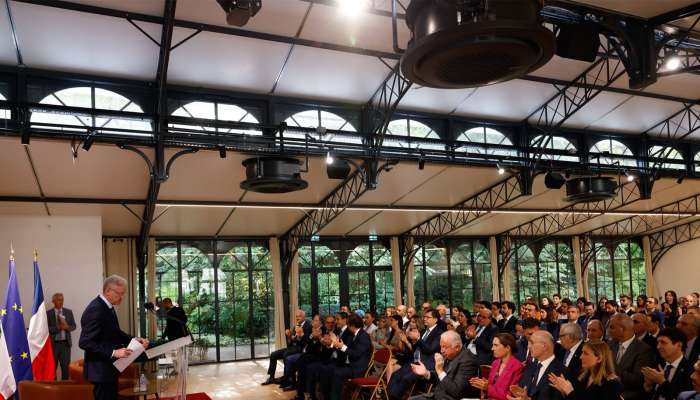
Paris: Lebanese Foreign Minister Youssef Raggi on Thursday declared that ending Hezbollah's military presence is a "sovereign Lebanese decision," marking a decisive shift in the country's efforts to consolidate state authority.
Reflecting on his remarks delivered at the French Senate, the Foreign Minister reaffirmed the sovereignty of Lebanon and announced that the nation will not return to duality. He announced the exclusion of "weapons" outside the state's authority.
"From the French Senate, I reaffirmed that Lebanon has made its choice: there will be no return to dual authority, and there is no longer any place for weapons outside the authority of the state or for decisions taken outside its constitutional institutions," he wrote in a post on X.
"The decision to end Hezbollah's military presence is a sovereign Lebanese decision. It preceded the Framework Agreement and paved the way for it, affirming that decisions on war and peace, as well as foreign policy, are now the exclusive prerogative of the Lebanese state," he added.
The foreign minister further clarified that the state's push to extend its control is tethered to broader security requirements for the nation. He stressed that the "full extension of the Lebanese Armed Forces' authority across the entire Lebanese territory remains inseparable from Israel's complete withdrawal from the Lebanese territories it continues to occupy".
Framing the path forward as a national reconstruction effort rather than a request for crisis management, Raggi told the Senate, "Lebanon today is not asking its friends to manage its crises, but to accompany its recovery. A genuine partnership is one that strengthens the state, consolidates its sovereignty, and is founded on the conviction that a free, sovereign, and democratic Lebanon is not a deferred aspiration, but an irreversible choice".
Last week, Al Jazeera reported that Lebanese President Joseph Aoun is preparing to travel to the White House before the end of July to meet US President Donald Trump in a visit aimed at advancing the framework agreement with Israel signed on June 26.
The visit follows a 17-minute phone call on July 5 between the two leaders that Aoun described as "good".
As cited by Al Jazeera, in an interview with Lebanese daily An-Nahar, Aoun acknowledged that the framework agreement is "not ideal", but that the Lebanese government's acceptance of it reflects the facts on the ground and the current balance of power in the south, which favours Israel.
"This is a framework, not an agreement with Israel... No one should bet on the Lebanese army's division, and I will not let my people die," Aoun said, adding that the deal would not stop Lebanon from pursuing its rights and recovering occupied land.
As cited by Al Jazeera, he also said the phased security transition would begin with a pilot deployment in Zawtar in the Nabatieh district, testing a model in which the Lebanese army takes exclusive control of specific towns to facilitate incremental Israeli military withdrawals. The comment comes amid concern that Israel could strike the nearby Ali Al-Taher hill.
Aoun said Lebanese officials had asked US Secretary of State Marco Rubio to ensure the hill remains under Lebanese army control, and that Israel's Prime Minister Benjamin Netanyahu had agreed to the proposal.
He also defended Lebanon's decision to send a minister to the funeral of Iran's late supreme leader Ayatollah Ali Khamenei, by saying that "Our diplomatic relations with Iran continue and are not severed."
The developments follow the formal signing of the trilateral framework agreement by the United States, Israel and Lebanon on June 26.