Tuesday 07 / April / 2026
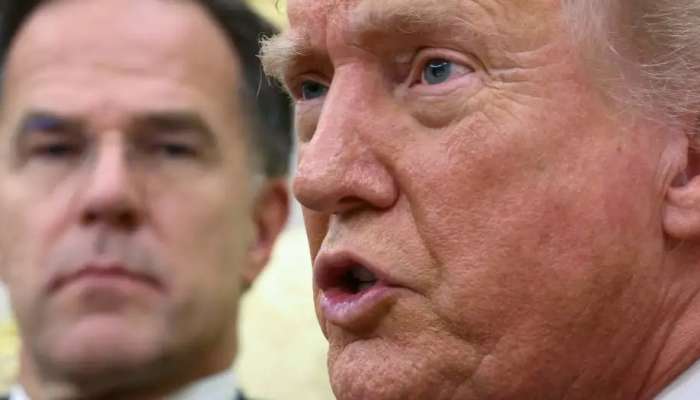
Brussels: “NATO is broken,” said Ivo Daalder, not mincing his words. The former US ambassador to the trans-Atlantic alliance believes tensions between Donald Trump and European allies over the Iran war have thrust NATO, which turned 77 years old this month, into the “worst crisis” in its history.
But alarm bells have been ringing for some time now. Already a year ago, Daalder published an article outlining how European member states might reconstruct NATO to function without the US, around whose leadership the organization was built.
Daalder, a senior fellow at Harvard’s Belfer Center, told DW that several factors have brought NATO to this low point. It’s not just the insults Trump flings at the alliance and its European members, to which they’ve become quite accustomed. Trump repeated his view on Monday that NATO is a “paper tiger” that won’t support the US in its war against Iran.
Nor, the former ambassador said, is it even Trump’s repeated threats to withdraw from NATO, which is accompanied by the more practical concern that he would be unwilling to participate in collective defense if another ally were attacked, the guarantee pledged by NATO’s Article 5.
Daalder said it is the combination of Trump’s vitriol along with the fact that many European governments have now gone beyond just refusing to help fight Washington’s war on Iran, with instances of denying Trump the right to use bases or refusing to grant airspace rights for offensive action.
“The European action is a reflection of the fact that NATO is deeply damaged,” he added, “and it reinforces the fundamental reality that Europe no longer trusts the United States, believes the United States is an unreliable ally, and therefore is no longer willing to participate in these kind of operations. That is why this is the worst crisis of NATO.”
NATO Secretary-General Mark Rutte has supported the US-Israeli action and played down the rift. “In the alliance, you will always have different views,” he said on March 26. “But when it comes to not accepting Iran having a nuclear and missile capability, we all agree ... What the United States is doing now is degrading that capability. And yes, I applaud that.”
Can Trump just leave?
Trump himself often publicly muses on an exit, saying recently that the prospect is “beyond reconsideration.” But no one knows for sure whether he’ll one day attempt to withdraw from the alliance.
What is known is that it wouldn’t be easy, thanks in part to his now secretary of state, Marco Rubio, who as a senator introduced legislation passed in 2023 that requires support from two-thirds of the Senate to leave.
Three years later, Trump insists he’d be able to do it anyway — and Daalder agrees with him, saying the constitutional challenge this could spark would likely favor the power of a president. Meanwhile, Rubio appears to have transitioned into a NATO skeptic.
From NATO’s side, there is an article in the 1949 Washington Treaty outlining the process for quitting, but it’s never before been used. Article 13 states that: “After the Treaty has been in force for twenty years, any Party may cease to be a Party one year after its notice of denunciation has been given to the Government of the United States of America, which will inform the Governments of the other Parties of the deposit of each notice of denunciation.”
Of course, there are plenty of ways Trump could kneecap NATO without leaving and without obtaining congressional approval. He could simply decide to bring troops home, cease supplying NATO commands and institutions with personnel — some of which is already happening — and even, to be very dramatic, decide not to staff the position of Supreme Allied Commander Europe, a military post that always goes to an American.
How would NATO react?
NATO would be hard-pressed to project credible power without the US, which has the largest and most advanced arsenal of weapons and the obvious advantage of a comparatively massive military force. But experts say the alliance wouldn’t necessarily collapse. It could continue a transition that’s already underway toward more European leadership and further reliance on European capabilities.
The International Institute for Security Studies (IISS) has researched what this could look like, urging “European decision-makers to consider the military, financial and defence industrial investments needed to reduce dependencies on the US and, in extremis, to prepare for a NATO without any US role.”
The picture isn’t rosy. Undertaken almost a year ago, the IISS assessment found that there would be serious shortfalls not just in replacing “major US military platforms and manpower “ but also in space and in intelligence, surveillance and reconnaissance assets. “They would also need to replace the significant US contribution to NATO’s command and control arrangements and fill many senior military positions in NATO organizations currently occupied by US personnel,” it found.
This would, the study estimated, require additional financing by European NATO members of an estimated trillion dollars on top of already increasing defence budgets.
Nick Witney, a former UK defence ministry staffer now working with the European Council on Foreign Relations, told DW that his “strong view is we just don’t bloody well need America now.” While Witney added that the “more American troops are around in Europe for the longest possible time, the happier I should be and happier all Europeans would be,” he doesn’t believe that “if Trump did turn around tomorrow and say, ‘All right, we’re all coming home, we’re through with you lot and you can forget about my nuclear guarantee,’ I really don’t feel that all will be lost.”
Part of this, he explained, is because of recent overtures made by French President Emmanuel Macron to several other allies about increasing nuclear cooperation outside NATO, as France does not currently make its own capabilities available to the alliance.
Rattled nerves, resolute stance
Estonian Foreign Minister Margus Tsahkna is perhaps the only European leader to have announced that his country is willing to help the Trump administration in Iran even before the war is over. But despite all the US accusations about a lack of support, he said there has been no actual request.
Tsahkna said his reason for offering is all about paying it forward. “Of course, this [anti-NATO] narrative is not good,” he told DW. “Estonian people are asking me and many other politicians every day whether NATO’s Article 5 is working or not.” Tsahkna advises all of Europe to “remain cool, let’s focus on what we can do and of course constantly we need to talk to the US administration,” reminding them that the US needs Europe too.
That is sure to be a key talking point for Rutte as he visits the White House on Wednesday, hoping to, as he has done before, elicit a positive response on NATO from Trump. In his remarks Monday, Trump called Rutte himself a “great person” but once again lambasted Europeans and other countries for failing to join the Iran war.
Trump ended his press conference with a cryptic, perhaps ominous, statement: “We want Greenland. They don’t want to give it to us. And I said, ‘bye-bye.’”