Sunday 08 / February / 2026
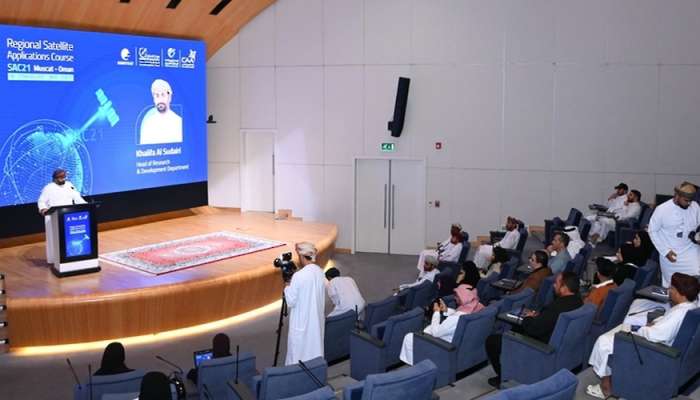
Muscat: The 21st Workshop on Satellite Applications commenced today. Organized by the Centre of Excellence for Satellite Applications in Muscat, which operates under the Civil Aviation Authority, in cooperation with the European Organization for the Exploitation of Meteorological Satellites (EUMETSAT), the workshop will run for five days.
This workshop is being held to enable participants to gain a grasp of satellite fundamentals and to introduce remote sensing systems and their diverse applications.
As many as 24 trainees from 11 Middle Eastern and North African countries are participating in the workshop, namely the Sultanate of Oman, the United Arab Emirates, the Kingdom of Saudi Arabia, the State of Qatar, the Republic of Yemen, the Republic of Iraq, the Hashemite Kingdom of Jordan, the Syrian Arab Republic, the Lebanese Republic, the Arab Republic of Egypt, and the State of Libya.
The workshop's activities include training specialists on the latest satellite applications, such as third-generation applications distinguished by their efficiency and high quality in covering the Arabian Peninsula and the Indian Ocean. This will enhance their capabilities to analyze and study various environmental and meteorological phenomena, alongside fostering the exchange of expertise and expanding the horizons of international cooperation among the participating countries.
Khalifa Salim Al Sadairi, Director of the Research and Development Department at the Civil Aviation Authority, stated: "Holding this workshop with the participation of an elite group of specialists from eleven countries in the Middle East and North Africa underscores the importance of joint regional work in developing our capabilities in the field of remote sensing and satellite applications. This is particularly crucial in light of the climatic challenges and extreme weather phenomena witnessed in our region."
He added, "The Centre of Excellence in Muscat was established in 2006 and was accredited by the World Meteorological Organization to serve as a regional platform for capacity building and knowledge transfer. Over nearly two decades, the Centre has contributed to training hundreds of specialists annually and has promoted integration among countries in utilizing satellite data to serve weather, climate, and marine environment monitoring."
He noted that this session is a continuation of the strategic partnership with EUMETSAT and falls within efforts to develop the use of third-generation satellite technologies. This contributes to enhancing the accuracy of forecasts and improving the quality of services provided to society.
In a statement to Oman News Agency (ONA), Abdullah Rashid Al Khudhouri, Director General of Meteorology at the Civil Aviation Authority, said: "This 21st edition of the workshop represents a significant regional milestone in the field of satellite applications and meteorological sciences. It reflects the pivotal role undertaken by the Sultanate of Oman in supporting and developing the technical capacities of countries in the Middle East and North Africa region."
He explained that this workshop serves as an advanced regional platform for exchanging expertise and transferring knowledge. It contributes to enhancing regional integration and cooperation in utilizing the latest satellite technologies, which positively reflects on improving the quality of meteorological services and supporting preparedness and risk reduction efforts related to weather and climatic phenomena across the region.
It is worth noting that the Centre of Excellence for Satellite Applications has been selected by the World Meteorological Organization as an accredited center for teaching satellite application sciences.