Wednesday 31 / December / 2025
Times News Service
MUSCAT: The Sultanate of Oman continues to cement its position as an emerging investment destination in the region, driven by well-established legislative and regulatory reforms and rapid digital transformation of government services. These efforts are aligned with Oman Vision 2040, which places economic diversification and investment at the forefront of national priorities.
Such reforms have contributed to significant improvements in the business environment, simplifying company establishment procedures and reducing operating costs, thereby enhancing the Sultanate’s attractiveness to both local and foreign investors.
In recent years, Oman’s investment climate has witnessed remarkable progress, reflecting the government’s strong commitment to modernising business systems and boosting the competitiveness of the national economy.
A key milestone in this journey was the promulgation of the Foreign Capital Investment Law under Royal Decree No. 50/2019, which abolished the minimum capital requirement for foreign investors with effect from January 2020. This step eliminated one of the major traditional constraints faced by investors and marked a turning point in improving market accessibility.
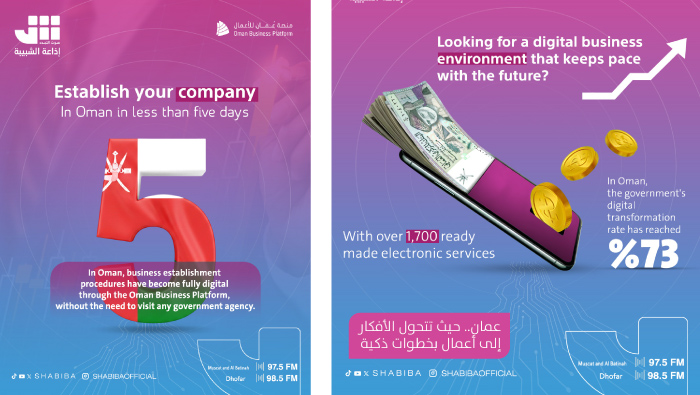
Oman has also adopted an ambitious government digital transformation programme, resulting in the digitalisation of more than 1,700 government services between 2021 and 2024. The rate of digital transformation rose to 73 per cent by the end of 2024, compared to 53 per cent in 2023.
This progress is clearly reflected in the Oman Business Platform, which completed over 827 transactions in 2024 — a 15 per cent increase compared to 2023. Additionally, the Sultanate achieved a score of 72 per cent in the Government Electronic and Mobile Services (GEMS) Maturity Index.
According to World Bank reports, Oman has made notable progress in reducing the time and procedures required to establish a business compared to neighbouring countries such as the UAE and Saudi Arabia. The average time required to establish a new company in Oman stands at between four and 4.5 days, with only four procedures and no minimum capital requirement. Furthermore, the cost of company establishment in Oman is among the lowest in the region, not exceeding three per cent of per capita income, compared to 17 per cent in the UAE and five per cent in Saudi Arabia.
Government digital platforms have played a pivotal role in accelerating these procedures.
The Ministry of Commerce, Industry and Investment Promotion launched the ‘Invest in Oman’ portal as a one-stop platform integrating services from 15 government entities, alongside the Oman Business Platform, which offers more than 15 integrated electronic services for the remote establishment and management of companies. Among these is the AI-powered Know Your Customer (KYC) digital service, which enables investors to establish companies from outside the Sultanate without the need for physical presence during the initial stages.
On the operational cost front, the government has taken tangible steps to support Small and Medium Enterprises (SMEs), including an 89 per cent reduction in expatriate labour permit fees for small companies registered with Riyada, in accordance with Ministry of Labour Decision No. 224/2022.
In parallel, Oman launched a long-term residency programme for investors at a time when foreign direct investment reached OMR 30 billion by the third quarter of 2024, reflecting the positive impact of ongoing economic reforms.
The Sultanate of Oman also benefits from political and economic stability, a reliable labour market, and a strategic location along key maritime trade routes connecting Asia and Africa. Looking ahead under Oman Vision 2040, the country is set to introduce further legislative enhancements, adopt smart and AI-supported solutions to deliver proactive investor services, expand public-private partnerships, and launch new economic zones to sustain growth and competitiveness.