Thursday 26 / November / 2026
India and Nepal have agreed to establish a satellite-based communication network to improve connectivity in remote Himalayan communities, using India's GSAT-9, also known as the South Asia Satellite.
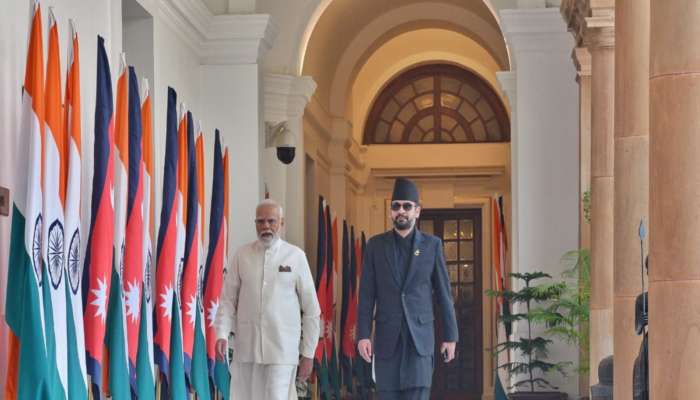
The agreement was reached during Nepal Prime Minister Balendra Shah's visit to New Delhi on November 23. A memorandum of understanding signed in the presence of the two leaders brings together the Indian Space Research Organisation (ISRO) and Nepal's Ministry of Information and Communication to develop the required infrastructure.
The proposed network will comprise a central ground station and 300 user terminals distributed across Nepal. India will provide 36 MHz of satellite bandwidth free of charge, enabling Nepal to use the communication capacity of an existing Indian satellite.
The initiative aims to address connectivity challenges in Nepal, where mountainous terrain, scattered settlements and high infrastructure costs have restricted the expansion of conventional telecommunications networks.
Satellite communication offers an alternative by allowing remote locations to exchange information through space-based links without relying entirely on terrestrial cables and mobile towers.
The network is expected to support essential public services, particularly healthcare, education and disaster management. Remote health facilities could use satellite connectivity to consult specialists, exchange medical information and access professional advice. Schools in isolated areas could benefit from online educational resources and remote teaching services.
The system could also strengthen emergency communication during earthquakes, landslides and floods, which frequently damage roads and disrupt conventional communication infrastructure in Nepal. Satellite links would provide an alternative channel for authorities to exchange information and coordinate rescue and relief operations.
An important feature of the agreement is that it does not require the development or launch of a new satellite. Instead, Nepal will use the existing capabilities of GSAT-9, launched by ISRO on May 5, 2017, while investing in the ground infrastructure needed to access its services.
GSAT-9 was originally conceived as the SAARC Satellite following an initiative proposed by Indian Prime Minister Narendra Modi at the 2014 SAARC summit. After Pakistan opted out, the project was renamed the South Asia Satellite.
India financed the satellite as a regional development initiative, making its communication capabilities available to neighbouring countries, including Nepal, Bhutan, Bangladesh, Sri Lanka, the Maldives and Afghanistan.
Operating in geostationary orbit, GSAT-9 carries Ku-band communication transponders designed to support broadcasting and other communication services. The satellite was developed to promote regional cooperation through applications such as distance education, telemedicine, disaster management and connectivity in geographically isolated areas.
The latest agreement seeks to translate this regional cooperation model into a practical communication network, extending the benefits of India's space programme to communities with limited access to digital infrastructure.
The initiative is part of broader efforts to strengthen India-Nepal relations. During Shah's visit, the two countries also introduced a joint vision document titled 'Viksit Bharat and Samunnat Nepal'.
Its 10-pillar framework identifies cooperation in connectivity, energy, water resources, climate resilience, disaster preparedness, digital services, sports, startups and technological innovation.
The satellite network adds a significant technological dimension to this partnership, with its success depending on the deployment of the ground station and 300 terminals and their effective integration into Nepal's public services.
For Nepal, the initiative offers an opportunity to extend reliable communication services to geographically isolated communities, while for India, it reinforces the role of its space capabilities in supporting regional development.