Wednesday 04 / November / 2026
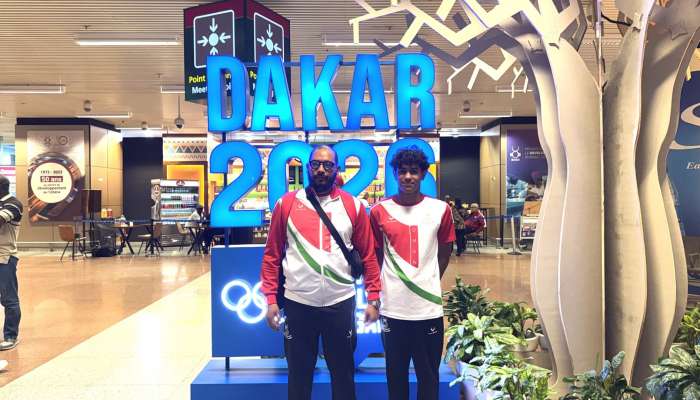
DAKAR, Senegal: Oman’s young swimmer Hamed al Hasani concluded recently his first Olympic campaign at the Dakar 2026 Youth Olympic Games with valuable experience and important lessons that he hopes to put into practice at the upcoming Arab Swimming Championships in Bahrain. Al Hasani finished second in the first heat of the men’s 400m freestyle, clocking 4 minutes 29 seconds, before placing 31st overall among 33 competitors. The event which was held at the Olympic swimming pool in the Complexe Tour de l’Œuf in Dakar.
He had also been scheduled to compete in the 800m freestyle, but the event was cancelled by the organisers due to high water temperatures in the Olympic pool. Saudi swimmer Rami Bilal al Rahmouni claimed the gold medal in the 400m freestyle with a time of 3:47, while Russia’s Bogdan Turbkin took silver in 3:50. Mexico’s Daniel Grillo completed the podium, securing bronze in 3:52.
Although his campaign ended in the preliminary round, Al Hasani now turns his attention to a new challenge represented at the Arab Swimming Championships in Bahrain which is scheduled for mid-November. The young swimmer is determined to make the most of the experience gained in Dakar as he continues his pursuit of stronger performances and podium finishes.
Lessons beyond the competition
Reflecting on his first appearance at the Youth Olympic Games, Al Hasani said the experience had marked an important milestone in his sporting career, providing him with valuable technical knowledge and personal development opportunities despite missing out on a place in the final. He explained that competing at such a high-level international event had helped him better understand the technical and physical demands of the sport, as well as identify the areas that require greater attention during his future training and preparation.
The Omani swimmer also highlighted the opportunity to observe how elite young athletes from different countries approach their training, preparation and competition, describing the direct interaction with international swimmers as one of the most valuable aspects of his participation.
He added that the benefits extended well beyond the pool. Living in the Olympic Village allowed him to meet athletes from different cultural backgrounds, build new friendships and learn more about the youth programmes offered by the Olympic movement, as well as its wider values and sporting culture. Al Hasani believes these experiences have given him additional motivation to work harder and continue developing his performance.
He admitted that he had hoped to achieve a better result in Dakar, but stressed that his ambition to win medals and reach the podium remains unchanged. He is now eager to translate the lessons learned at the Games into improved results in upcoming competitions. His next assignment will be the Arab Swimming Championships in Bahrain, where he is expected to compete in four freestyle events: the 200m, 400m, 800m and 1,500m. He aims to challenge for medals and deliver his best possible performances.
Bouguera: A valuable foundation for future progress
National aquatics head coach Mohamed Bouguera also underlined the benefits of al Hasani’s participation in Dakar, describing the Games as an important learning opportunity for the young swimmer, despite his failure to advance to the final. The Algerian coach said the event had given Al Hasani the chance to observe high-performance swimmers at close quarters and gain insight into their training methods and preparation routines. He noted that exposure to international competitors had helped the Omani swimmer learn more about training programmes, nutritional requirements, physical and technical preparation, and the race strategies used at a high level. These lessons, he added, would contribute to broadening the swimmer’s technical understanding and improving his future performances. Bouguera also pointed to several organisational and logistical challenges encountered during the competition.
He said some of the facilities and services required by athletes at the Olympic Village were not available, while conditions at the Olympic swimming pool in the Complexe Tour de l’Œuf presented further difficulties. The large number of participating swimmers led to congestion around the pool’s warm-up facilities, while limited opportunities to train during the daytime, due to high temperatures, created additional challenges for preparation.
The coach expressed hope that these issues would be considered in future editions to ensure athletes have suitable facilities and conditions to prepare effectively and benefit fully from major international competitions. Despite these challenges, Bouguera believes the experience in Dakar provides a valuable foundation for the next stage of Al Hasani’s development. The coaching team will seek to incorporate the positive lessons from the Games into the swimmer’s training programme ahead of the Arab Championships in Bahrain.
Taekwondo and fencing next for Oman
With Oman’s participation in aquatics now complete, the focus will turn to the national taekwondo and fencing athletes, who are gearing up to compete in the remaining events at Dakar 2026. Taekwondo athlete Ziyad al Balushi is scheduled to compete in the men’s under-48kg category on November 8 at the Iba Mar Diop venue in Dakar. Meanwhile, fencer Jana al Sharji will represent Oman in the women’s individual épée event on November 10 at Dakar Expo in Diamniadio, making her the final Omani athlete to compete at this edition of the Games.




