Wednesday 23 / September / 2026
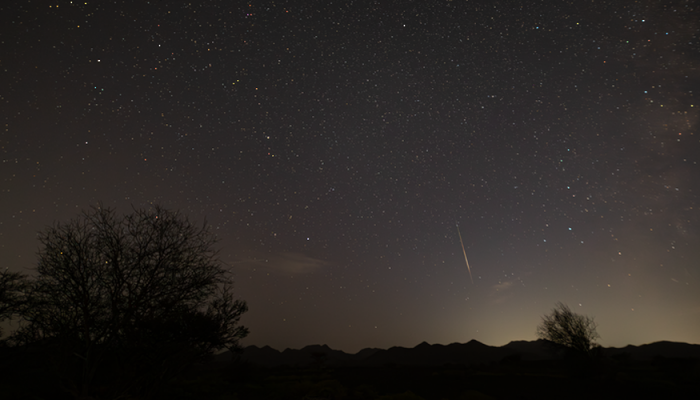
Muscat: The sky of the Sultanate of Oman witnessed the observation and documentation of 332 meteors from the Perseid meteor shower during its peak night, under ideal astronomical conditions coinciding with the new moon phase. This provided a dark, moonlight-free sky that contributed to observing the meteors and recording the shower's activity rate over several hours.
Ibrahim Mohammed Al Mahrouqi, Vice Chairman of the Board of Directors of Oman Astronomical Society, explained that the observation process took place at a suitable location far from sources of light pollution with the participation of seven people. The process began before the official documentation period, during which more than 35 meteors were recorded, before systematic documentation started from 12 midnight until 4 AM, recording 297 meteors.
Observation results showed a gradual increase in meteor counts as the hours of the night progressed. Between 12 and 1 AM, 42 meteors were recorded, rising to 62 meteors from 1 to 2 AM, then to 85 meteors between 2 and 3 AM, before activity reached its peak with 108 meteors recorded between 3 and 4 AM. This aligns with the preference for observation after midnight until shortly before dawn, when the Perseid radiant point rises higher in the sky.
Al Mahrouqi pointed out in a statement to Oman News Agency (ONA) that the goal of the documentation process lies in studying the Zenithal Hourly Rate (ZHR), which serves as an important indicator in studying meteor shower activity. Collecting data regularly over years provides information regarding the nature and distribution of dust and debris left behind by the comet "Swift–Tuttle" in its orbit around the Sun. Comparing activity rates from year to year reveals the density and distribution of debris and whether Earth passed through denser dust regions, in addition to developing models that help predict years that might witness strong meteor activity.
He added that studying the particles resulting from the comet and analyzing their sizes and distribution provides indicators of how the comet's nucleus disintegrates and changes over time. It carries practical importance in understanding the nature of space debris and assessing its potential impact on satellites during periods of high meteor activity. He noted that the elevation of the radiant point is an influential factor in the number of visible meteors, alongside the direction of Earth's movement around the Sun, as the part of Earth facing the direction of motion collides with a larger number of meteoritic particles, making the hours preceding dawn among the best times for observing meteor showers.
He stated that recording more than 100 meteors during the final hour of documentation reflects the quality of observation conditions and relative sky darkness, providing an indicator of the strength of the shower's activity during the peak night. He pointed out that determining the proportion of meteors belonging to the Perseids also depends on tracking their paths and linking them to the shower's radiant point. He emphasized that the absence of moonlight provided exceptional conditions, offering a better opportunity to observe faint meteors that might be difficult to see on moonlit nights, alongside bright meteors and fireballs.