Wednesday 20 / May / 2026
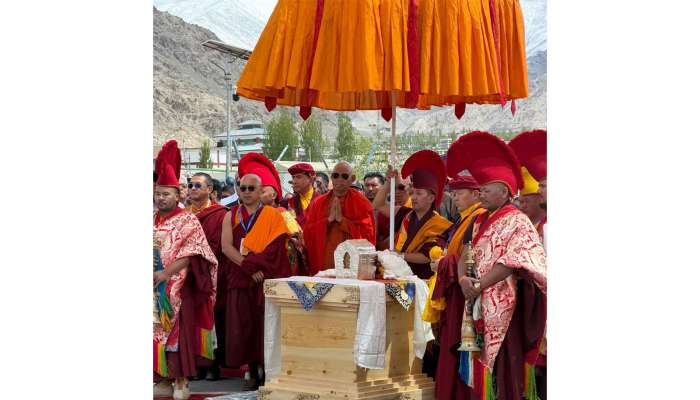
The ongoing celebration of Buddha Purnima in Ladakh in May 2026 emerged as one of the most significant spiritual and diplomatic events organised in contemporary India. The “Sacred Exposition of the Holy Relics of Tathagata Buddha,” held across Leh and Zanskar from 1–14 May 2026, combined faith, culture, heritage and diplomacy into a single civilisational initiative.
Prime Minister Narendra Modi on Saturday expressed "immense delight" following the inauguration of the 'Sacred Exposition of the Holy Relics of the Tathagata' in Leh, marking a significant spiritual milestone for the region on the auspicious occasion of Buddha Purnima.
The exposition, which showcases ancient relics linked to the Piprahwa Stupa in Kapilavastu, is expected to draw thousands of devotees and tourists to the high-altitude union territory.
In a post on X, the Prime Minister highlighted the historical and spiritual significance of the relics linked to the Piprahwa Stupa in Kapilavastu.
Organised through the collaborative efforts of the Ministry of Culture, UT Ladakh Administration, the International Buddhist Confederation, National Museum of India, the Archaeological Survey of India, the Ladakh Buddhist Association, the Ladakh Gonpa Association and other institutions, the exposition reflected India’s growing use of Buddhist heritage as an instrument of cultural diplomacy and global outreach.
The event coincided with the observance of the 2569th Vesak Buddha Purnima and witnessed an unprecedented public display of the sacred Piprahwa relics associated with Lord Buddha. These relics, preserved at the National Museum in New Delhi, were brought to Ladakh allowing devotees, monks, scholars, tourists and international observers an opportunity for veneration and reflection.
The Holy Relic Exposition represented the convergence of spirituality and statecraft. Through this initiative, India projected itself as the custodian of the Buddha’s heritage and reinforced its civilisational identity in the international arena. The exposition highlighted how Buddhism continues to serve as an important pillar of India’s soft power diplomacy, especially in Asia and the Himalayan region.
Buddha Purnima and the Sacred Geography of Ladakh
Buddha Purnima commemorates the birth, enlightenment, and Mahaparinirvana of Gautama Buddha and remains the holiest day for Buddhists across the world. In 2026, the celebration assumed special significance in India because Ladakh became the focal point of the observance. Ladakh, often described as a “living land of Dhamma,” possesses deep historical and spiritual connections with Buddhism through monasteries, traditions and trans-Himalayan cultural exchanges.Ladakh is also prominent in terms of its critical location along the India-China border. There have been several occasions when due to high tension along the border, people of Ladakh have contributed significantly towards supporting the defence fences during their movements.
The celebrations were organised across important centres such as Jivetsal, Dharma Centre, Central Institute of Buddhist Studies and Mahabodhi International meditation Cere in Leh and Karsha Photang Gompa in Zanskar. Public processions, prayers, meditation sessions, conferences, cultural performances, and exhibitions accompanied the exposition of the sacred relics. Thousands of devotees from across Ladakh and other parts of India gathered for darshan of the relics, creating a spiritually charged atmosphere marked by reverence and unity.
The extension of the exposition to Zanskar carried additional significance. Remote Himalayan communities were directly connected to a national and international Buddhist initiative, demonstrating India’s commitment to preserving Himalayan Buddhist traditions and integrating them into broader cultural diplomacy efforts. This was also a special gesture for the old and the infirm and beyond and who live in the region and beyond and who can probably never see the relics otherwise.
The Historical Significance of the Holy Relics
The relics displayed during the exposition originated from Piprahwa in present-day Uttar Pradesh, identified by many scholars with ancient Kapilavastu, associated with the Shakya clan of Gautama Buddha. These relics were discovered in 1898 beneath an ancient stupa and remain among the most sacred Buddhist relics in the world.
Their display in Ladakh symbolised the return of the Buddha to the Himalayan land of devotion. The exposition also acquired historical significance because the relics had recently been repatriated and preserved as part of India’s cultural heritage initiatives. The Indian government presented the exposition as a reaffirmation of India’s civilisational responsibility toward preserving Buddhist heritage for humanity.
The movement of the relics from the National Museum to Ladakh through coordinated efforts involving religious institutions, government agencies, and Buddhist organisations demonstrated the integration of state institutions with cultural diplomacy. The relics thereby became not only sacred objects of worship but also symbols of India’s civilisational continuity and heritage preservation.
India’s Buddhist Soft Power Diplomacy
Soft power refers to the ability of a country to influence others through culture, values, heritage and ideas rather than coercion or military force. Buddhism has increasingly become one of India’s most effective instruments of soft power diplomacy. As the land of the Buddha’s birth, enlightenment, teachings and Mahaparinirvana, India possesses unmatched spiritual legitimacy in the Buddhist world.