Wednesday 08 / April / 2026
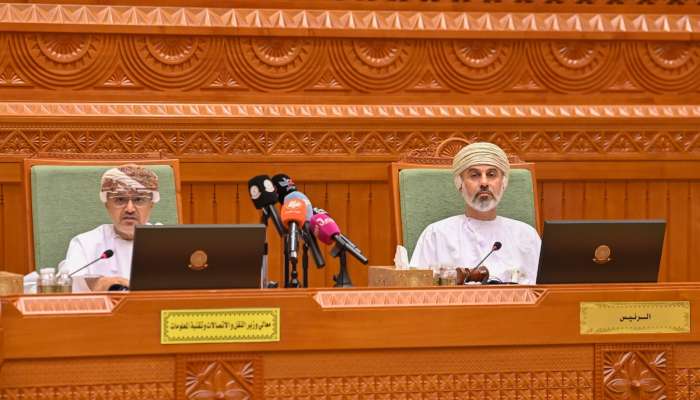
Muscat--- The Shura Council today hosted Eng. Said bin Hamoud Al Maawali, Minister of Transport, Communications and Information Technology, during its fourteenth regular session of the third annual sitting of the tenth term to discuss the ministry’s performance across three core axes and to review key projects and initiatives aligned with Oman Vision 2040. The discussions focused on developing the transport, communications, IT, logistics and artificial intelligence sectors.
The ministerial statement covered the ministry’s actual performance during the Tenth Five-Year Development Plan (2021–2025), its planned projects under the Eleventh Five-Year Development Plan (2026–2030), and an overview of sectors under its supervision.
The minister reported that the Tenth Five-Year Plan delivered substantial progress in infrastructure development across transport, logistics, communications and IT, including strategic projects and transformative initiatives that yielded major advances in roads, land and maritime transport, logistics and the National Digital Economy Programme.
In the roads sector, the minister said that projects valued at over RO 1.2 billion were either implemented or launched during the plan period. These initiatives have directly enhanced governorate connectivity, improved road network efficiency and eased traffic flow—supporting both economic and social activity. Land transport revenues grew by 18 percent in 2025, reflecting greater operational efficiency and rising service demand.
He pointed out that Omani ports achieved advanced operational performance, with cargo handling surpassing 143 million tonnes and container throughput exceeding 5.1 million TEUs in 2025. Strategic initiatives—including capacity expansion, re-planning, upgraded maritime services, and investments in marine fuel and ship recycling—helped drive port revenue growth of 17.4 percent and a 9.4 percent increase in maritime affairs revenue.
The minister added that investment in the logistics sector reached approximately RO 3.3 billion during the Tenth Five-Year Plan, supported by improved performance metrics and better integration across transport modes. In 2025 alone, 18 investment agreements worth over RO 100 million were signed, while Omanisation in the sector stood at 21.6 percent.
On government digital transformation, he noted a qualitative leap in service development and efficiency. More than 3,166 government services have been streamlined, and 2,277 services and permits digitised. Government digital transactions exceeded 48 million in 2025—an increase of nearly 78 percent from 2024—while electronic authentication operations surpassed 200 million.
In the field of artificial intelligence (AI) and advanced digital technologies, the Minister of Transport, Communications and Information Technology confirmed that investments by several major private sector companies in this domain have surpassed RO 79 million. A number of landmark national initiatives have been launched, most notably the Omani large language model “Mu'een AI”— the first national model of its kind — alongside the establishment of the Artificial Intelligence Studio and the development of a startup-friendly ecosystem. The number of specialized companies in this field has reached approximately 22, advancing the localization of cutting-edge technologies and boosting productivity across various sectors.
He noted that the Sultanate of Oman has witnessed a significant expansion in communications networks, with mobile broadband population coverage reaching approximately 99 percent, while high-speed fixed broadband services now cover 100 percent of residential units through fibre optics, fifth-generation technologies, and low Earth orbit satellites. This has strengthened the readiness of the digital environment and enabled the delivery of advanced services.
The minister highlighted that Oman has achieved a remarkable milestone in cybersecurity, securing a top-tier global ranking in the 2024 Cybersecurity Readiness Index. Programmes and initiatives have benefited more than 8,000 beneficiaries within the Sultanate of Oman and 5,000 internationally. Over 11,000 national cadres have been trained in the digital industry and capacity building, with Omanis now holding approximately 69 percent of technical, specialized and leadership positions in the information technology sector. Omanisation in the sector stands at 45.5 percent — a clear testament to the success of efforts to empower national talent and enhance their participation in the digital economy. The technology startup ecosystem has also grown to exceed 200 companies.
He reported that the space sector has seen notable growth, marked by the launch of the first experimental space rocket from the Duqm launchpad in 2024 and the signing of the Omani satellite project. The sector has expanded to include 25 companies and provide approximately 401 jobs, reflecting Oman's push to diversify the digital economy into advanced fields, with investments in the space sector reaching RO 74 million.
The minister added that the e-commerce market volume reached approximately RO 288 million in 2025, with more than 14,000 licences issued for commercial activities and 313 e-stores registered on the "Ma'ruf Oman" platform, thereby boosting consumer confidence and regulating the digital business environment.
The financial technology sector recorded a 703 percent increase in non-cash transactions between 2020 and 2025, the minister noted. Four national payment systems have been developed, 10 fintech companies have been licensed, and 39 financial institutions have joined the "Huwiyya" platform — all supporting the transition to a cashless economy and fostering financial innovation.
He affirmed that these collective efforts have yielded a direct economic impact, with core digital economy activities contributing approximately RO 800 million in 2023. The first national digital economy survey, covering more than 1,300 establishments, has been completed, providing an accurate database to inform future policymaking.
Looking ahead to the roads sector under the Eleventh Five-Year Development Plan (2026–2030), the minister said the focus will be on completing ongoing projects, several of which have already surpassed 70 percent completion. The ministry intends to implement a series of vital and strategic projects during this plan to strengthen Oman's road network infrastructure and enhance connectivity between governorates and economic centres.
He further stated that during the Eleventh Five-Year Development Plan, the ministry aims to implement the Oman Ports Strategy to enhance competitiveness, accelerate the transition toward low-emission green ports, expand green fuel projects and ship recycling and develop small and medium-sized ports through concession agreements. Key future projects include the green fuel production project at Salalah Port, concession agreements for the ports of Shinas and Khasab, the development of Sultan Qaboos Port — encompassing a tourist berth and breakwater — and the development of khawrs (creeks), namely Khawr Jarama in Sur, Khawr Al Fawaris in Barka and Khawr Al Mughsayl in Salalah.
The minister affirmed that during the Eleventh Five-Year Development Plan, the ministry is concentrating on an integrated package of operational projects to raise the efficiency of the national logistics system and strengthen its integration. This includes expanding the Port Community System to cover all land, sea and air ports, implementing logistics linkage projects between ports, free zones and airports to support multimodal transport, developing national supply chains and enhancing their operational efficiency and expanding digital transformation applications to accelerate procedures and improve service quality. These efforts are coupled with attracting high-value investments and strengthening public-private partnerships to generate added value for the national economy.
He noted the launch of the second phase of the National Digital Economy Programme (2026–2030), designed to maximise economic impact by focusing on the digitalisation of vital economic sectors and promoting the adoption of advanced digital technologies — foremost among them artificial intelligence — thereby boosting productivity and improving service and process efficiency across sectors. This phase prioritises a transition toward more integrated and proactive government models, employing AI in decision-making, developing national proactive intelligence platforms, and establishing digital transformation centres in each governorate tailored to local economic characteristics. These initiatives aim to foster balanced development and raise sectoral readiness.
The minister added that efforts will now turn to localising digital industries through the development of domestic cloud computing systems, enabling the manufacture and assembly of digital infrastructure components and strengthening the national data ecosystem — including an integrated environment for satellite data processing to support economic and research sectors.
On enabling the digital economy, he affirmed that the next phase will focus on accelerating the growth of digital companies, enhancing the innovation environment, empowering national companies in cybersecurity and advanced technologies, developing digital payment systems and strengthening financial autonomy in the digital infrastructure.
Eng. Said bin Hamoud Al Maawali, Minister of Transport, Communications and Information Technology, outlined the programme's 2030 targets: raising the direct contribution of the digital economy to approximately RO 1.5 billion in GDP, attracting RO 300 million in foreign technology investment, adding 100 new technology startups to the market, creating nearly 14,000 jobs, increasing the digitalisation rate of five targeted economic sectors to 85 percent and enabling the listing of five technology companies on the financial market.
The session was chaired by Khalid bin Hilal Al Maawali, Chairman of the Shura Council, in the presence of Sheikh Ahmed bin Mohammed Al Nadabi, Secretary-General of the Council.