Thursday 01 / October / 2026
Muscat: Picture a Saturday afternoon in July. Muscat is pushing past 45 degrees. Every air conditioner in the capital is running flat out. Three hundred kilometres west, a bank of clouds drifts over the Ibri solar farm and generation drops by a third in ninety seconds. Meanwhile, wind picks up along the Dhofar coast earlier than forecast, flooding the southern grid with power it was not expecting.
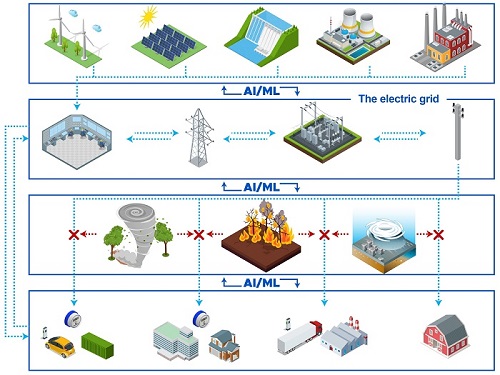
Someone has to balance all of that, instantly, across thousands of kilometres of wire. For most of the last century, that someone was a human being in a control room, picking up a phone. But the old grid was simpler. Power flowed one way: from a big plant to your house. Renewables have rewritten those rules. Solar panels push electricity back into the network. Batteries absorb and release on their own schedule. Wind arrives and vanishes with the weather. The grid is no longer a continuous stream. It is a conversation between multiple assets happening in every direction at once.
It is a puzzle playing out on every continent. The more solar, wind or geothermal a country adds, the more its grid starts to behave less like a machine and more like a living system, constantly shifting, constantly needing to be rebalanced.
One answer gaining serious traction is called agentic AI. The concept is simple. Instead of software that waits for a human command, you build software that watches the entire network, spots trouble forming, and acts on its own within safe limits. It reroutes power. It charges or discharges batteries. It dials generation up or down. All in milliseconds. The difference between this and traditional automation is like the difference between a thermostat that reacts when the room gets hot and a building manager who checks tomorrow's forecast, pre-cools the lobby at dawn, and adjusts every floor before the first person walks in. One reacts. The other plans.
Oman is approaching this shift from a position of genuine strength. The Oman Electricity Transmission Company has spent twenty years building a modern network that now spans 116 grid stations and over 10,400 kilometres of high-voltage lines, with reliability at 99.9999 percent. The Rabt project is stitching previously separate regional grids into one unified national system. OETC leadership has publicly described an ambition to build a world-class, self-healing grid, with SCADA systems and AI-based forecasting already becoming central to daily operations.
The national AI ecosystem is keeping pace. Oman's National Programme for AI and Advanced Digital Technologies targets $400 million in investment and names smart grid management as a priority. A UNESCO-recommended National AI Supercomputer Centre would support energy and climate simulations at scale.
Then there is hydrogen. Hydrom has allocated land to consortia planning around 35 gigawatts of renewable capacity. Those electrolysers will need stable, round-the-clock power, which makes grid intelligence not a luxury but a necessity.
Most countries building smarter grids are retrofitting intelligence onto wiring that predates the internet. Oman, with a recently unified national network built to modern standards, has the rarer option of embedding agentic intelligence from the start.
*The author is a student at the British School Muscat and writes about technology