Tuesday 05 / May / 2026
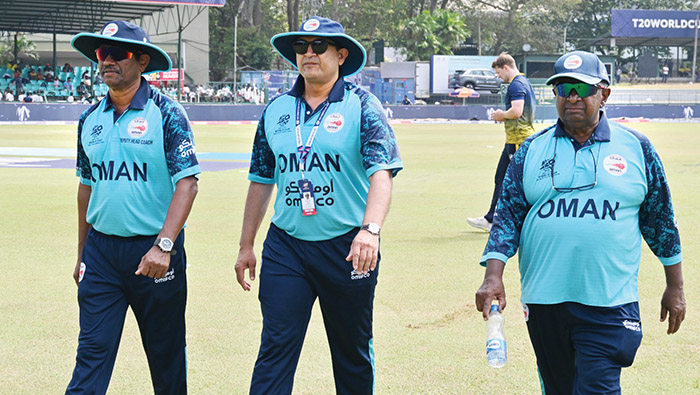
Muscat: The defeats hurt. They always do on a stage as unforgiving as the ICC Men's T20 World Cup. Four matches, four losses, and an early exit from Group B in Sri Lanka - the bare numbers suggest a campaign to forget. But numbers rarely tell the whole story.
For Oman national cricket team, this was not merely about results. It was about arrival, exposure and evolution. It was about an Associate nation standing shoulder to shoulder with the game’s heavyweights - and realising just how fine the margins are at the highest level.
Calling it what it was, Alkesh Joshi, national team manager and senior board member of Oman Cricket (OC), offered both honesty and hope in equal measure.
In an exclusive interview with Times of Oman after the team’s return to Muscat earlier this week, he said: “It has been a steep learning curve for Oman at the T20 World Cup. But, we are proud of the boys for being among the top 20 teams in the world.”
That pride is grounded in perspective. Qualifying marked Oman’s fourth appearance at the T20 World Cup in ten years, an extraordinary benchmark for an Asian Associate nation — the only country to have done it.
Back-to-back entries to the global showpiece underline a consistency that many in the Associate fold aspire to but few achieve.
“To put Oman on the world map in cricket is not easy,” Joshi reflected. “But we did it with pride under coach Duleep Mendis, who has an enviable record of steering the team to four T20 World Cups, starting from 2016.”
Under the experienced Sri Lankan tactician, Oman have built structure and belief. Yet this edition exposed the reality of transition. Ten of the 15 squad members were World Cup debutants, a statistic that explains as much as it excuses.
“Yes, the boys could have done much better and they are capable of it,” Joshi admitted.
“But the stage was big for them. Playing a World Cup for the first time is a different game. It brings pressure, and they possibly were not able to handle it.”
Even so, there were reassuring signs. Senior cricketers Mohammad Nadeem and Aamir Kaleem struck composed half-centuries, reaffirming that experience still anchors the side when the stakes are high.
“The experienced players showed their mettle. The debutants now know what is required at that platform. The experience they gained will stand them in good stead,” said Joshi.
For captain Jatinder Singh, the campaign, despite its frustrations, was a matter of honour.
“Representing Oman at the global stage was a moment of pride,” he said after the defeat against Australia to conclude their campaign at the beautiful Pallekele International Cricket Stadium in Kandy.
“We got a chance to play in a group that comprised four Test-playing nations including former world champions - Sri Lanka and Australia - Zimbabwe and Ireland.”
Those contests against them were lessons delivered at full pace. Jatinder conceded that preparations could have been stronger, particularly the lack of exposure against higher-ranked opposition.
“We hope Full Member nations come to support Associate nations like us.”
The losses in Sri Lanka will linger. But within the dressing room, there is resolve rather than regret.
“The boys have taken a lot of learning from this tournament,” Jatinder said. “We return from this campaign with positives that we hope to use to our benefit in the upcoming challenges."
Those challenges shift format and focus. Oman now turn to the 50-over game and the ODI League 2 series in Nepal next month, a competition that offers both continuity and redemption.
Joshi remains confident. “I am certain our boys will bounce back stronger,” he said. “We are optimistic of a better show in this format with coaching staff that includes Mendis and India’s Sulakshan Kulkarni along with other support team.”
For an Associate nation that has carved a place among the world’s top 20, growth sometimes comes wrapped in hard lessons.